



About#
AIdsorb is a Python package for deep learning on porous materials.
It is designed to automate the repetitive tasks common to deep learning workflows, allowing researchers to focus on developing and testing new ideas instead of writing boilerplate code.
Deep and machine learning projects often repeat the same workflow: generating inputs, preparing datasets, configuring models, and launching training runs. Managing these workflows consistently can quickly become cumbersome.
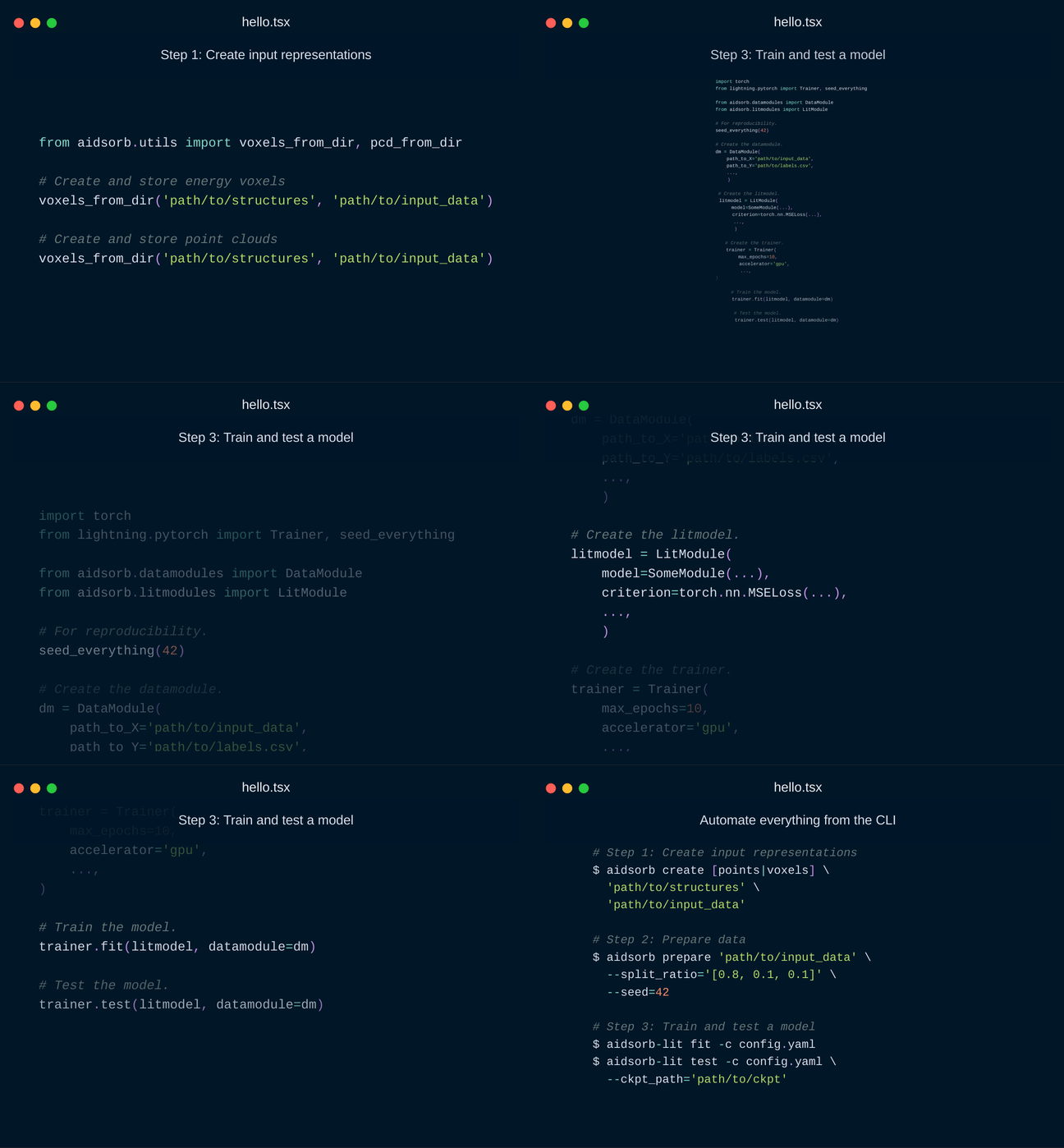
AIdsorb provides a unified, configuration-driven interface to:
🛠️ Generate input representations of materials.
🗂️ Prepare and manage datasets.
🤖 Train and fine-tune models with minimal boilerplate.
🔬 Build reproducible and repeatable deep learning workflows.
TODO#
Enable users to predict from the command line.
Enable users to fine-tune models trained on large data.
Provide clean and fast implementations!
Add more featurization options. These should be fast!
Contributing#
We welcome contributions from the community! Please read our Contributing Guide before submitting PRs or opening issues.
Citing#
Please refer to the citation file or click the citation button on GitHub.
@article{Sarikas2024,
  title = {Gas adsorption meets geometric deep learning: points, set and match},
  volume = {14},
  ISSN = {2045-2322},
  url = {http://dx.doi.org/10.1038/s41598-024-76319-8},
  DOI = {10.1038/s41598-024-76319-8},
  number = {1},
  journal = {Scientific Reports},
  publisher = {Springer Science and Business Media LLC},
  author = {Sarikas,  Antonios P. and Gkagkas,  Konstantinos and Froudakis,  George E.},
  year = {2024},
  month = nov
}
License#
AIdsorb is released under the GNU General Public License v3.0 only.
User Guide
Reference